
A groundbreaking discovery in the world of entomology has revealed a startling reproductive strategy in Iberian harvester ants (Messor ibericus). Researchers from the University of Montpellier have unveiled that these ant queens possess the unique ability to produce offspring belonging to two distinct species: their own and the closely related Messor structor.
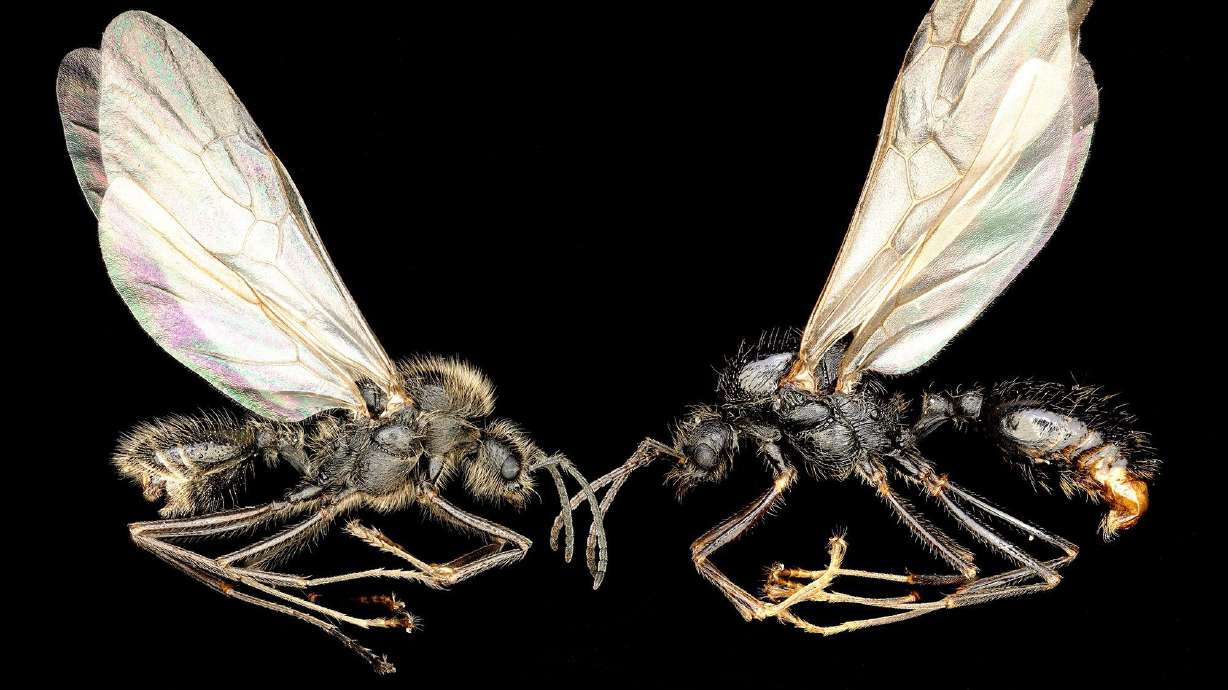
This astonishing finding emerged during an investigation into the unexpected presence of Messor ibericus colonies on Sicily, hundreds of miles from the nearest known Messor structor population. Initial hypotheses suggested hybridization, but genetic analysis revealed a far more complex reality.
Over five years, the research team studied over 120 ant populations across Europe, sequencing hundreds of ant genomes and conducting meticulous laboratory experiments. Their observations revealed that a single Messor ibericus queen could produce both hairy Messor ibericus males and hairless Messor structor males. This remarkable feat stems from the queen's ability to selectively manipulate the development of her eggs.
The queen's reproductive strategy revolves around a need for both purebred Messor ibericus males (to produce future queens) and a workforce of hybrid Messor structor workers, which constitute 99% of the colony. The queen achieves this by a process involving the cloning of Messor structor male genetic material from stored sperm, a phenomenon known as sexual domestication. This process essentially involves the deletion of her own nuclear DNA, leaving the offspring reliant almost entirely on the father's genetic material. This is a form of androgenesis, combined with the production of hybrid offspring, a previously unseen combination in the ant world.
This unique reproductive mode, termed xenoparous, challenges conventional understanding of ant reproduction and even animal reproduction in general. The ability to produce offspring of a different species as an integral part of the life cycle is unprecedented. The researchers note that while the cloned offspring strongly resemble their father, minor genetic mutations accumulate over generations.
The study's authors highlight the evolutionary significance of this discovery. The evolution of xenoparity in Messor ibericus likely stemmed from a historical dependence on Messor structor males for worker production, later evolving into a sophisticated cloning mechanism. This allowed Messor ibericus to expand their range significantly, but potentially at the cost of long-term genetic diversity and species survival. Future research will focus on elucidating the precise cellular mechanisms behind the queen's remarkable cloning abilities, potentially offering insights into artificial cloning techniques in other species. The discovery adds a fascinating new chapter to our understanding of the intricate and diverse world of ant reproduction and evolution.
---
Originally published at: https://www.ksl.com/article/51374638/ant-queen-gives-birth-to-2-different-species


