
A groundbreaking discovery has sent ripples through the astrophysics community: astronomers have identified a supermassive black hole in the early universe that's growing at an astonishing rate—2.4 times the theoretical Eddington limit. This extraordinary finding challenges our current understanding of black hole formation and growth in the cosmos.
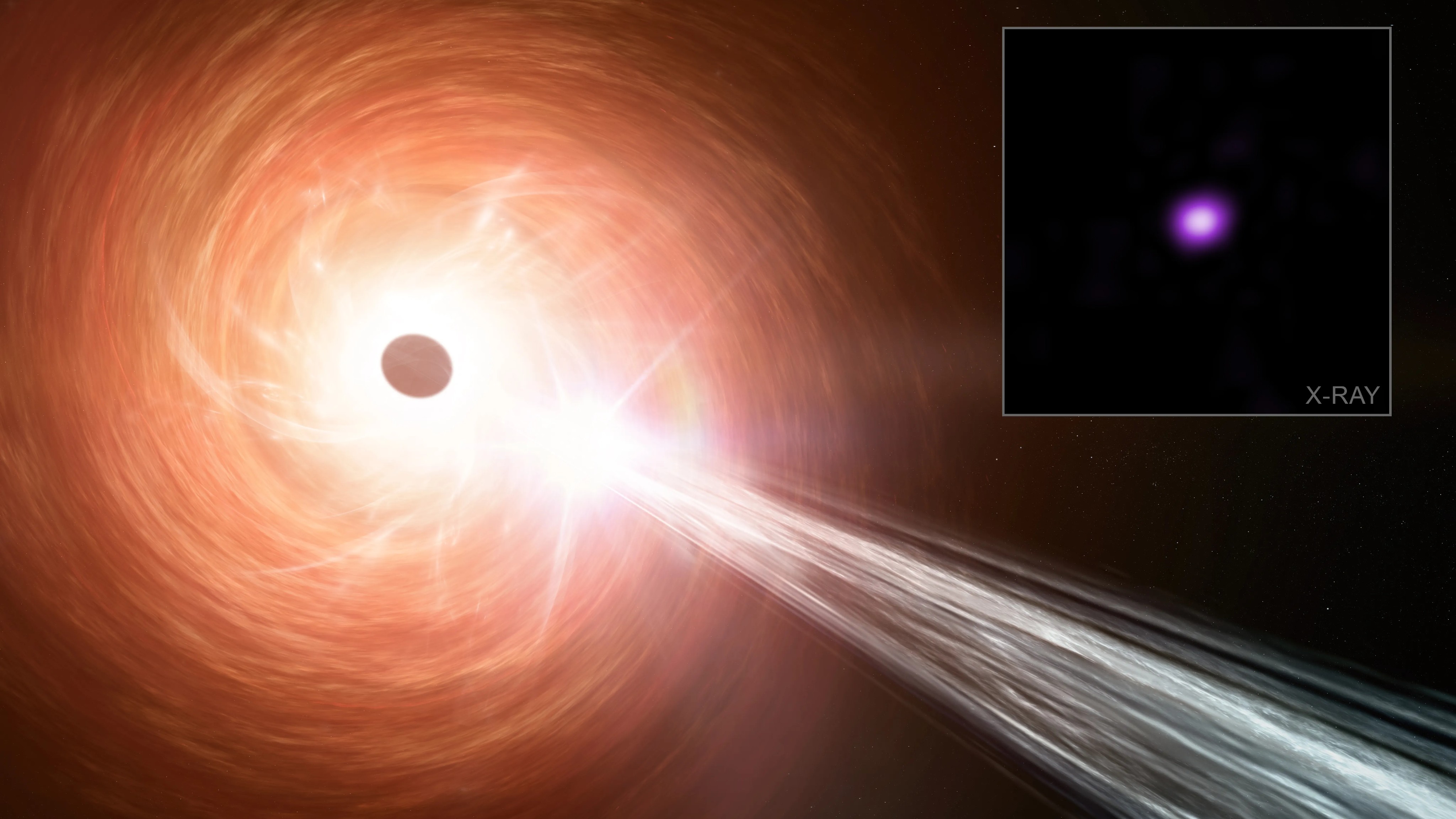
Located in the constellation Eridanus, the black hole, designated RACS J0320-35, existed a mere 920 million years after the Big Bang. Despite its relatively young age in cosmic terms, it has already amassed a mass equivalent to a billion suns. This rapid growth, exceeding the theoretical limit that governs how quickly black holes can accrete matter, has left scientists baffled.
Using data from NASA's Chandra X-ray Observatory, researchers analyzed the intense X-ray, infrared, and optical radiation emitted by the black hole. This analysis revealed an accretion rate significantly higher than previously considered possible. The black hole is consuming an estimated 300 to 3,000 solar masses of material annually, exceeding the Eddington limit by a considerable margin.
The Eddington limit represents the theoretical upper boundary for the rate at which a black hole can grow. It's determined by the balance between the inward gravitational pull and the outward pressure of radiation generated by the infalling matter. The fact that RACS J0320-35 surpasses this limit indicates a potential flaw in our current theoretical models or the presence of unknown mechanisms that facilitate its hyper-growth.
This discovery is not an isolated incident. Other 'super-Eddington' black holes have been observed in the early universe, suggesting that rapid growth may be more common in the ancient cosmos than previously anticipated. This opens up exciting avenues of research into the formative stages of the universe and the processes that lead to the formation of these colossal celestial objects.
The researchers posit that the black hole likely originated from the collapse of a relatively large star, potentially under 100 solar masses, and subsequently underwent extraordinarily rapid growth. This rapid growth could also explain the quasar-like characteristics of RACS J0320-35, which emit powerful energy jets piercing the cosmos. Further investigation into this and similar black holes will be crucial in unraveling the mysteries surrounding the universe's earliest black holes and their surprisingly swift evolution.
---
Originally published at: https://www.livescience.com/space/black-holes/shocking-black-hole-found-growing-at-2-4-times-the-theoretical-limit


