
A newly identified interstellar wanderer, christened 3I/ATLAS, is sending ripples of intrigue through the astronomical community due to its astounding estimated mass. Scientists now believe its nucleus could tip the scales at an incredible 33 billion tons, positioning it as a true heavyweight among cosmic bodies.
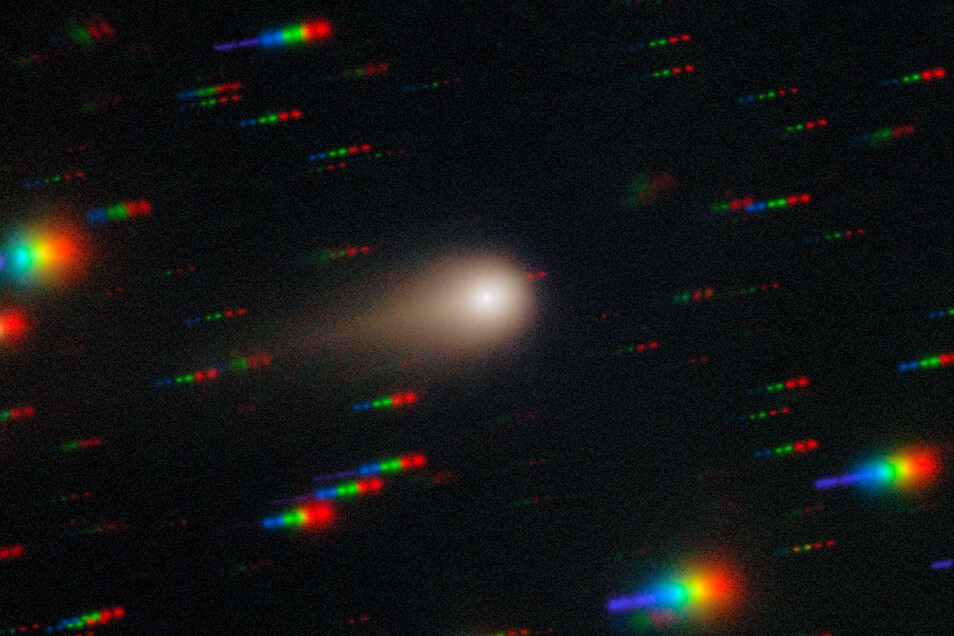
This extraordinary comet first came into view on July 1, 2025, detected by the ATLAS survey telescope located in Chile. Subsequent examination of archival imagery confirmed its hyperbolic trajectory, indicating its origin lies beyond our solar system. This makes 3I/ATLAS only the third interstellar object ever confirmed, following in the celestial footsteps of 'Oumuamua (2017) and Borisov (2019).
What truly distinguishes 3I/ATLAS is its apparent gargantuan scale. A recent analysis, spearheaded by Harvard astrophysicist Avi Loeb, highlights a peculiar observation: the comet exhibits no measurable non-gravitational acceleration. This is unusual because comets typically experience subtle nudges from the jets of gas and dust they expel. Yet, 3I/ATLAS undeniably displays a coma and a tail—clear indicators of active outgassing. Loeb posits that for its shedding material to have no discernible impact on its movement, the comet's nucleus must possess an exceptionally high mass. His calculations suggest a mass exceeding 33 billion tons, potentially dwarfing both of the previously confirmed interstellar visitors.
Despite its unusual bulk, spectroscopic data from both the James Webb Space Telescope and NASA's SPHEREx mission (observed August 7-15) have revealed the presence of water and carbon dioxide ice, confirming its composition aligns with that of a typical comet. However, its sheer size remains a perplexing paradox. Conventional wisdom suggests that smaller interstellar objects should be more prevalent and easier to detect, yet this enormous comet appeared before the hundreds of predicted minuscule ones.
Loeb has even ventured a controversial hypothesis, suggesting 3I/ATLAS might not be entirely natural, leaving open the intriguing, albeit speculative, possibility of alien technology should future observations detect signs of controlled movement. While most astronomers regard this as pure speculation, there is universal agreement on the comet's singular and unusual nature.
For Earth, there is no cause for concern. On October 3, 2025, 3I/ATLAS will safely pass Mars at a distance of approximately 17 million miles. It is then projected to make a close approach of about 0.36 AU from Jupiter in March 2026, an encounter that could potentially offer NASA's Juno spacecraft a unique opportunity for a closer inspection of this remarkable interstellar giant.
---
Originally published at: https://www.chron.com/news/space/article/interstellar-comet-3i-atlas-size-21074858.php


