
The James Webb Space Telescope (JWST) has captured a breathtaking image of a massive star located on the outskirts of our Milky Way galaxy, blasting out twin jets of cosmic material spanning an astonishing eight light-years. This remarkable observation, detailed in a recent Astrophysical Journal publication, provides invaluable insights into the formation of the universe's most colossal stars.
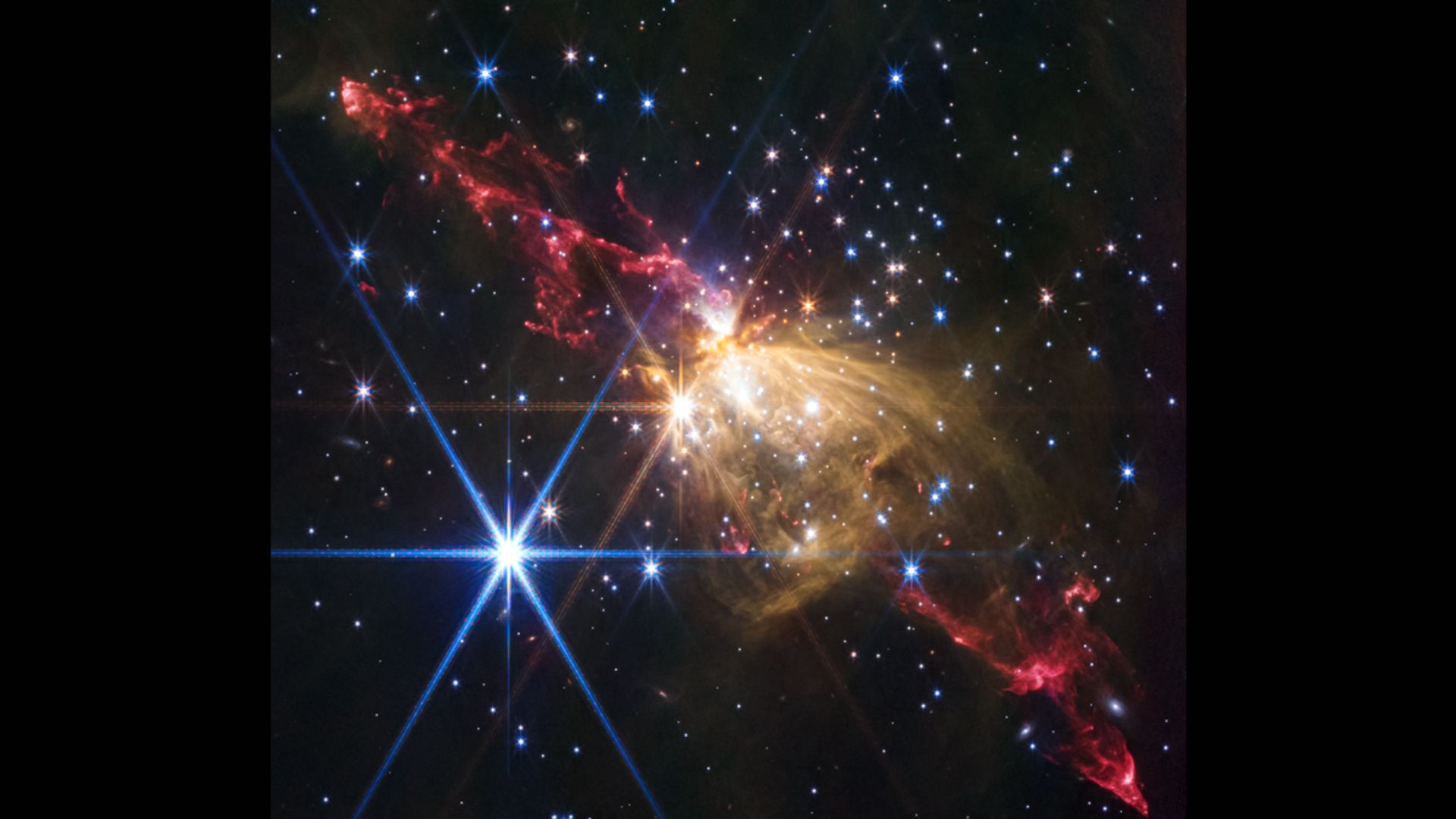
The jets, emanating from a star within the nebula Sharpless 2-284 (Sh2-284), are propelled by the immense force of material falling onto the growing star. This material accumulates in a disk around the protostar, with some being absorbed to increase its mass. However, excess material is ejected via powerful magnetic fields, forming the spectacular jets that extend at hundreds of thousands of miles per hour.
Unlike the relatively orderly formation of lower-mass stars, theories suggest that the accretion process for massive stars is more chaotic. This should lead to wobbling stars and erratic jets. Surprisingly, the JWST images of Sh2-284's jets are exceptionally straight and point almost 180 degrees apart. This strongly suggests a far more controlled accretion process than previously imagined for such stars, challenging established theories.
Jonathan Tan of the University of Virginia and Chalmers University of Technology, and Yu Cheng of the National Astronomical Observatory of Japan, who led the JWST observations, emphasize the significance of this discovery. The size of the jets is directly correlated with the star's size, indicating a star approximately ten times the mass of our sun, still actively growing and powering this extraordinary outflow.
The location of Sh2-284 in a low-metallicity environment on the Milky Way's edge offers a unique advantage. This environment mirrors conditions in the early universe, providing a rare opportunity to study star formation under primordial conditions. The jets' tips, representing the oldest material, have moved outward for over 100,000 years, leaving a trail that chronicles the star's history. While the growing star itself isn't directly visible due to foreground stars, the JWST clearly shows the intricate structure of Sh2-284, including filaments, knots, and bow shocks resulting from the jets' interaction with the interstellar medium.
Despite their dramatic display, these jets are a temporary phenomenon. Eventually, the star will emerge from its cocoon, possibly reaching tens of times the mass of our sun, before ending its life in a supernova explosion. This explosive event will create a new nebula—a nebula of stellar death, rather than birth—yet enriching space with the heavy elements forged within the star. The cycle of stellar birth and death continues, endlessly shaping the cosmos.
---
Originally published at: https://www.space.com/astronomy/james-webb-space-telescope/james-webb-space-telescope-images-enormous-star-shooting-out-twin-jets-8-light-years-long


