
The James Webb Space Telescope (JWST) has made a startling discovery: enigmatic "dark beads" in Saturn's upper atmosphere. These unusual features, unlike anything previously observed, were detected by JWST's Near Infrared Spectrograph (NIRSpec) above the planet's famous hexagonal jet stream at the north pole. The findings, published in Geophysical Research Letters, have left scientists baffled.
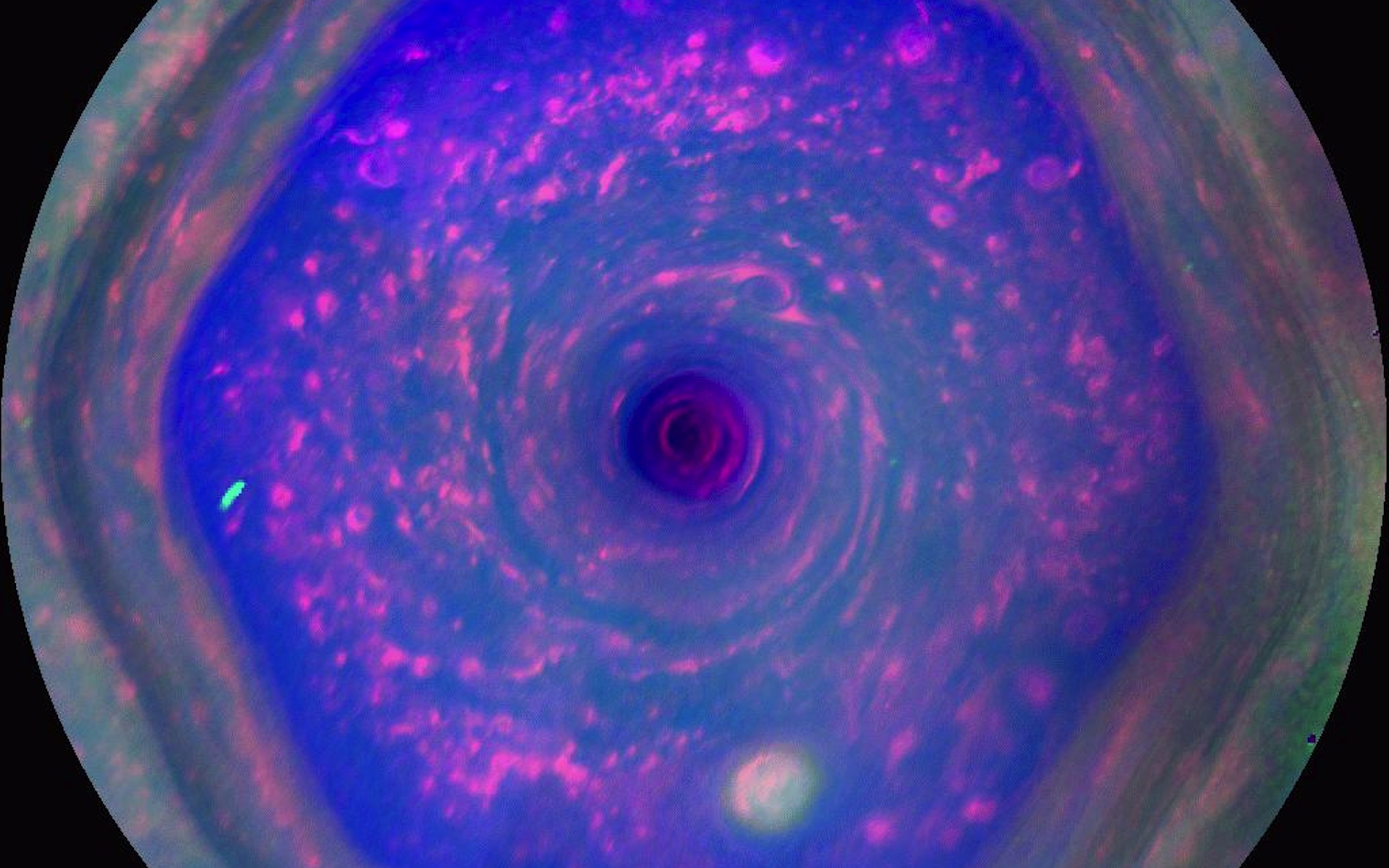
The dark beads, separated by vast distances yet possibly interconnected, appear to drift within the charged plasma of Saturn's ionosphere. Simultaneously, researchers observed an asymmetrical, star-shaped structure in the stratosphere below. These unexpected structures were detected while studying hydrogen and methane molecules in the planet's ionosphere and stratosphere, approximately 1100 km and 600 km above the nominal surface, respectively.
Professor Tom Stallard of Northumbria University, a key researcher on the project, stated that the discovery was completely unexpected and currently lacks a definitive explanation. The team initially anticipated observing broad infrared emissions from the atmospheric layers above the hexagonal vortex, a feature first observed by Voyager and extensively studied by Cassini. The hexagon itself, a colossal 29,000-kilometer-wide structure, remains a scientific enigma, with its formation and behavior still not fully understood. The intricate interplay between Saturn's jet stream and atmospheric gases is believed to play a crucial role.
The researchers hypothesize that the dark beads might stem from complex interactions between Saturn's magnetosphere and its rotating atmosphere. This interaction could offer vital insights into the energy exchange that drives Saturn's auroras. The asymmetric star pattern, meanwhile, may potentially be linked to the hexagonal storm, although further investigation is required to confirm this connection.
The team plans to conduct follow-up observations with JWST to unravel the mystery of these features and their impact on Saturn's atmospheric dynamics. Saturn's current equinox presents a unique opportunity, as the changing sunlight may cause significant alterations in the observed patterns. The planet's close approach to Earth on September 21st will also provide optimal viewing conditions for further study.
---
Originally published at: https://www.livescience.com/space/completely-unexplained-james-webb-telescope-finds-strange-dark-beads-in-saturns-atmosphere


