
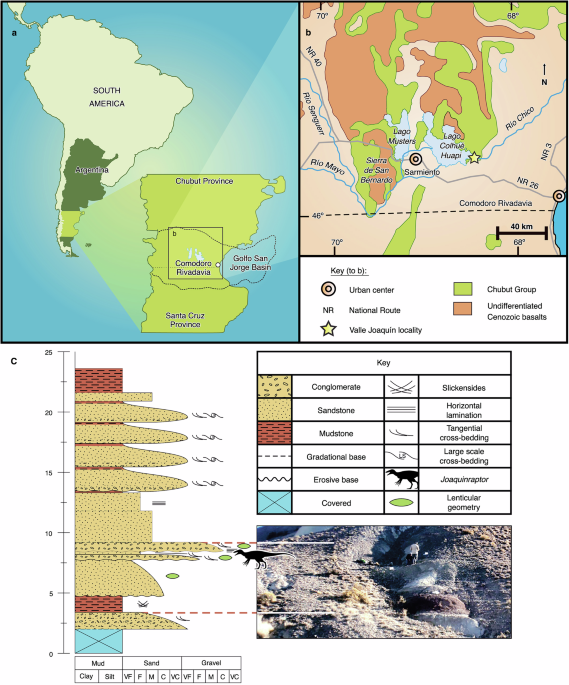
The discovery of *Joaquinraptor casali*, a new genus and species of megaraptorid theropod dinosaur, significantly advances our understanding of megaraptoran evolution and paleobiology. This remarkably well-preserved partial skeleton, unearthed from the uppermost Cretaceous Lago Colhué Huapi Formation in central Patagonia, Argentina, represents one of the most complete and geologically youngest megaraptorans ever discovered. Its stratigraphic position, just meters below the formation's top, indicates that these dinosaurs likely persisted until the Cretaceous-Paleogene boundary.
Megaraptora, a group of large-clawed carnivorous dinosaurs, have a predominantly Gondwanan distribution, with fossils found in Asia, Australia, and South America. While earlier megaraptorans originated in Asia and Australia, they are particularly abundant in the Late Cretaceous of Patagonia. The evolutionary relationships of Megaraptora within the Tetanurae remain debated, with ongoing discussion of their placement as either carcharodontosaurian allosauroids or early coelurosaurs.
*Joaquinraptor casali* is classified as a member of the Megaraptoridae subclade based on key anatomical features, including reduced anteriormost dentary alveoli, the absence of mesial denticles from tooth crowns, and a characteristically shaped ulna. Unique features, or autapomorphies, distinguish *Joaquinraptor* from other megaraptorids, such as the strongly transversely compressed parietals and the unique morphology of its caudal vertebrae. The discovery of a crocodyliform humerus closely associated with the *Joaquinraptor* specimen offers intriguing insights into potential dietary preferences and feeding strategies, though further taphonomic analysis is necessary to confirm the nature of this association.
Osteohistological analysis of the *Joaquinraptor* tibia and dorsal rib reveals a minimum age of 19 years, suggesting sexual maturity at the time of death. This analysis also provides valuable data on the reliability of different bones for age estimation in non-avian dinosaurs. The study found that long bones, like the tibia, provided a more complete growth record than ribs, particularly due to the effects of pneumaticity and bone remodeling.
Phylogenetic analysis places *Joaquinraptor* within Coelurosauria, as the sister group of Tyrannosauroidea. It emerges as an early diverging member of a newly identified clade of derived South American megaraptorids, referred to as Megaraptorid Clade 1 (MC1), characterized by narrow parietals. Further research is required to validate the monophyly and taxonomic content of MC1.
The discovery of *Joaquinraptor* supports the hypothesis that megaraptorids were apex predators in Late Cretaceous central and southern Patagonia, a stark contrast to the more northerly regions dominated by abelisaurids and unenlagiines. The megaraptorids' apparent adaptability to varying paleoclimatic and paleoenvironmental conditions may have been facilitated by their unique forelimb morphology, which likely played a crucial role in prey capture and manipulation. The exceptionally well-preserved specimen provides critical new data on this enigmatic group of dinosaurs, offering a clearer picture of their evolutionary trajectory and ecological roles in the Late Cretaceous.
---
Originally published at: https://www.nature.com/articles/s41467-025-63793-5


