
Northrop Grumman's enhanced Cygnus XL cargo spacecraft successfully completed its mission to the International Space Station (ISS), delivering over 5 tons of crucial supplies and scientific experiments. Launched on Sunday aboard a SpaceX Falcon 9 rocket, the mission encountered a minor setback on Tuesday. During critical engine burns designed to fine-tune its approach to the ISS, the Cygnus's main engine unexpectedly shut down prematurely on two separate occasions.
Initial concerns were quickly addressed by NASA and Northrop Grumman engineers. A thorough investigation revealed the issue stemmed not from hardware malfunction, but rather a conservative software safeguard designed to protect the spacecraft from potential damage. This proactive safety measure, while causing a delay, ultimately prevented a more significant problem.
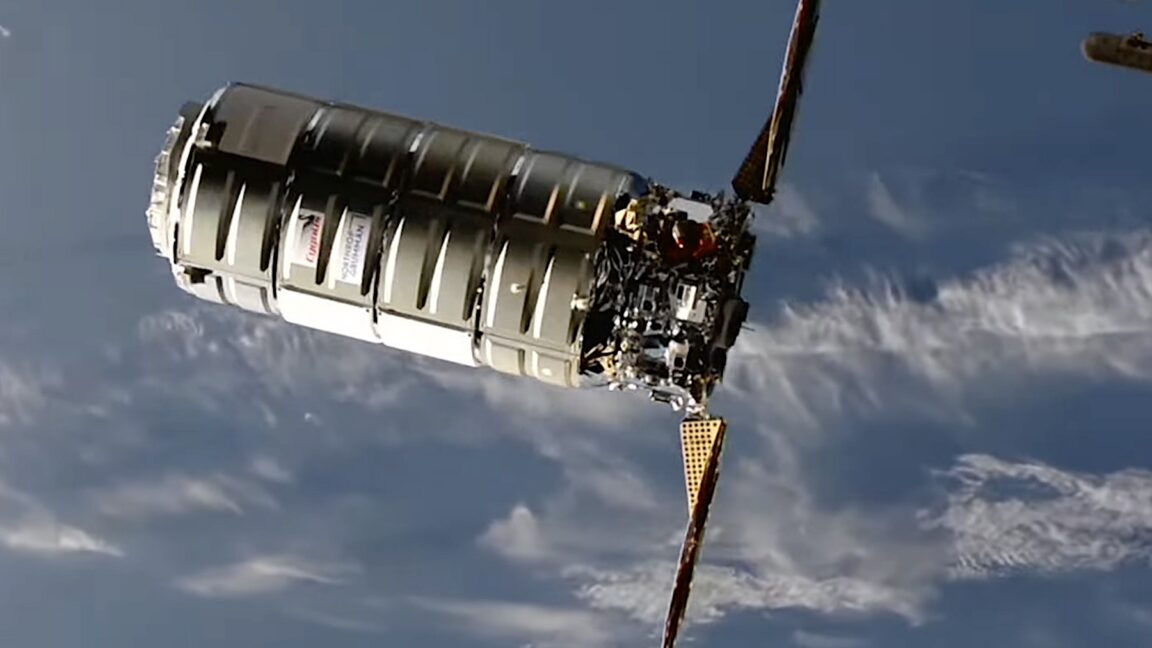
After implementing updated software parameters, the Cygnus XL autonomously navigated to within 30 feet of the ISS. NASA astronaut Jonny Kim then expertly used the station's robotic arm to capture and secure the spacecraft at 7:24 am EDT on Thursday. The spacecraft is now firmly attached to the Unity module via sixteen bolts.
This successful docking marks the first flight of Northrop Grumman's upgraded Cygnus XL, boasting a 5.2-foot extension to its cargo module, resulting in a 33% increase in carrying capacity. The impressive 10,827-pound payload includes essential supplies such as food, oxygen, nitrogen, and spare parts for the station's vital urine processor—crucial for recycling waste into potable water. Furthermore, the Cygnus XL delivered a new advanced navigation aid for future spacecraft docking, significantly improving efficiency and safety for upcoming missions.
The mission's scientific payload is equally significant, featuring experiments focused on semiconductor crystal production in microgravity and innovative methods for maintaining cryogenic propellants during prolonged spaceflight. The Cygnus XL will remain docked at the ISS for approximately six months before a controlled destructive reentry over the Pacific Ocean, concluding this critical resupply mission.
---
Originally published at: https://arstechnica.com/space/2025/09/a-software-glitch-not-an-engine-failure-delayed-a-critical-iss-cargo-delivery/


