
For the first time, scientists have measured not only the speed but also the direction of a black hole's recoil after a collision, using gravitational waves. This groundbreaking achievement, based on data from the 2019 event GW190412, offers unprecedented insights into these colossal cosmic events.
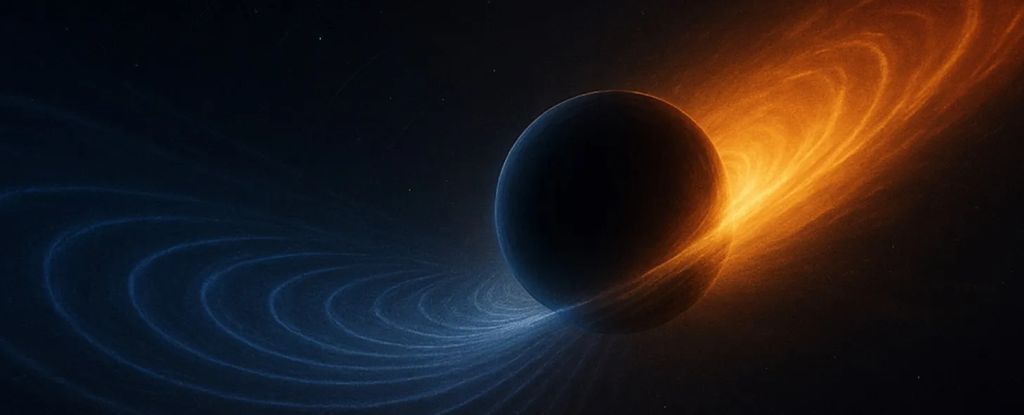
The unequal masses of the two colliding black holes – one 29.7 times the mass of our Sun and the other a mere 8.4 solar masses – resulted in a significant 'kick.' The newly formed black hole was propelled through space at an astonishing speed exceeding 50 kilometers per second. This 'natal kick,' a consequence of an uneven energy release, was precisely measured, revealing the black hole's three-dimensional trajectory.
"This is a landmark achievement," explains astrophysicist Koustav Chandra of Pennsylvania State University. "We've reconstructed the complete 3D movement of an object billions of light-years away, solely by analyzing the ripples in spacetime – gravitational waves." This accomplishment showcases the extraordinary power of gravitational wave astronomy, a field just a decade old but already revolutionizing our understanding of the cosmos.
Gravitational waves, analogous to ripples in a pond, are generated as black holes spiral toward each other, their gravitational fields distorting spacetime. The collision culminates in a powerful gravitational 'bloop,' the merger creating a single, more massive black hole. Scientists meticulously decode these ripples to extract crucial information about the black holes' individual masses, spins, and the characteristics of the merged object.
Astrophysicist Juan Calderon-Bustillo of the University of Santiago de Compostela describes the process: "Think of a cosmic orchestra. Different positions relative to the event yield unique combinations of signals, allowing us to pinpoint the source's location and motion." This innovative analysis method, developed by Calderon-Bustillo and his colleagues, was successfully applied to GW190412, yielding the precise measurement of the black hole's recoil.
The exceptional length of the gravitational wave signal from this merger, a result of the disparate black hole masses, proved crucial in providing the detailed data needed for this precise measurement. The ejected black hole's speed is sufficient to potentially propel it out of a globular cluster, were it situated within one. While we cannot currently confirm this due to distance limitations, the discovery represents a remarkable leap forward in our ability to study these violent cosmic events.
According to astrophysicist Samson Leong of the Chinese University of Hong Kong, "This new technique opens exciting possibilities. In dense environments, the recoiling black hole could generate detectable electromagnetic flares as it moves through the surrounding matter. By measuring the recoil, we can distinguish between genuine gravitational wave-electromagnetic pairings and mere coincidences." This research, published in Nature Astronomy, signifies a significant step towards a more complete understanding of black hole mergers and their impact on the universe.
---
Originally published at: https://www.sciencealert.com/sound-of-a-black-hole-kicked-through-space-heard-in-a-stunning-first


