
In a groundbreaking launch, a SpaceX Falcon 9 rocket propelled three vital scientific missions towards the Sun-Earth L1 Lagrange point, a location nearly a million miles from Earth. This unprecedented 'cosmic carpool' represents a significant advancement in our understanding of space weather, the heliosphere, and Earth's upper atmosphere. The combined cost of these missions nears $1.6 billion, highlighting the substantial investment in unraveling the mysteries of our solar system.
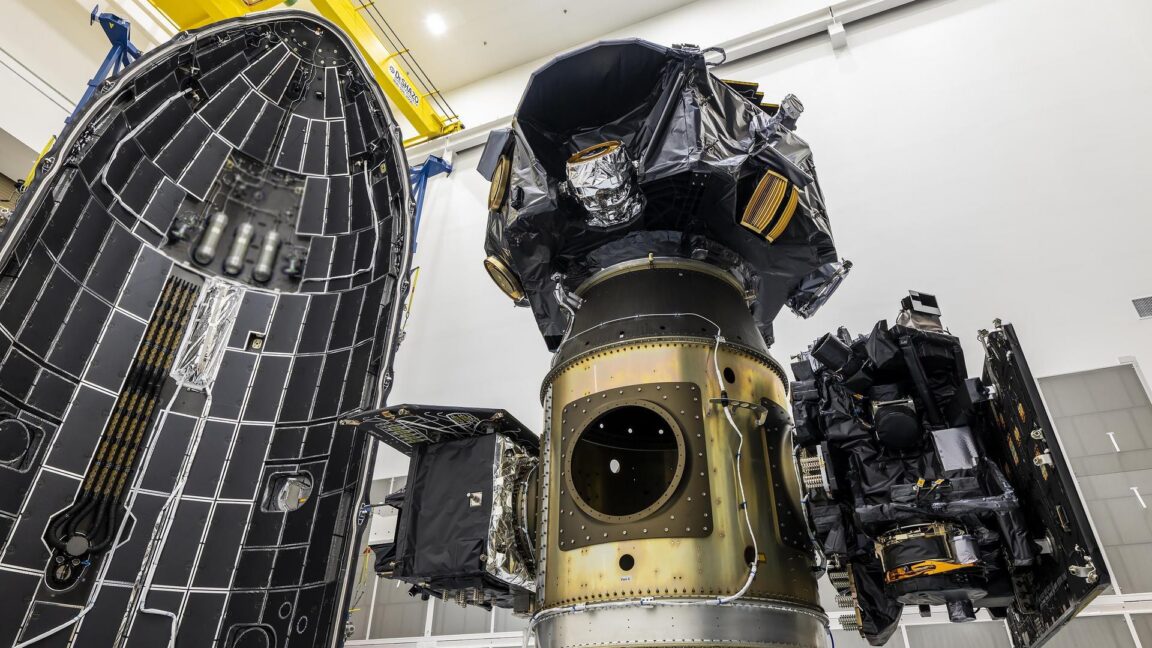
Leading the trio is NASA's Interstellar Mapping and Acceleration Probe (IMAP), a donut-shaped spacecraft tasked with mapping the heliosphere's outer boundary. This ambitious mission aims to understand the interaction between the solar wind and interstellar medium, crucial for comprehending the heliosphere's role in shielding our planet from harmful cosmic rays. IMAP’s innovative instruments will analyze ions, interstellar dust, and energetic neutral atoms, offering unprecedented insights into this poorly understood frontier. The mission will spend at least two years collecting invaluable data, expanding upon the findings of its predecessor, IBEX, which unexpectedly discovered a ribbon-like pattern of energetic neutral emissions.
Accompanying IMAP is the Carruthers Geocorona Observatory, a smaller mission dedicated to studying Earth's geocorona – a faint glow of hydrogen emanating from our planet's exosphere. Named after the pioneering solar physicist George Carruthers, this mission, using two ultraviolet imagers, seeks to understand the size, shape, and density of the geocorona, which is believed to play a vital role in the effects of solar storms on Earth. The mission aims to improve our understanding of this often-overlooked aspect of our planet’s atmospheric interaction with space.
The third mission, the Space Weather Follow On-L1 (SWFO-L1), from NOAA, represents a landmark achievement in space weather forecasting. This $692 million mission acts as an early warning system for potentially devastating geomagnetic storms. Positioned at the L1 Lagrange point, SWFO-L1 will provide real-time observations of the solar wind, giving crucial advance notice to power grids, airlines, and satellite operators, potentially mitigating billions of dollars in damages from future storms. Upon reaching its designated orbit, SWFO-L1 will be renamed SOLAR-1, marking the beginning of a new era in space weather monitoring.
The decision to launch all three missions simultaneously resulted in substantial cost savings, avoiding the need for three separate launches. While rideshare missions to low Earth orbit are becoming commonplace, this multi-mission deployment to a distant Lagrange point showcases exceptional planning and coordination, offering a potent example of collaborative efficiency in space exploration. The combined efforts of NASA and NOAA underscore the importance of understanding our place within the cosmos, and the concerted effort to protect our planet from the sometimes-destructive forces of space weather.
---
Originally published at: https://arstechnica.com/space/2025/09/a-cosmic-carpool-is-traveling-to-a-distant-space-weather-observation-post/


