
Our solar system resides within a vast, protective bubble known as the heliosphere. This enigmatic structure, formed by the constant flow of charged particles from the sun (the solar wind), shields our planets from the harsh cosmic radiation permeating the Milky Way galaxy. The heliosphere plays a crucial role in the existence of life on Earth and potentially on other planets like Mars.
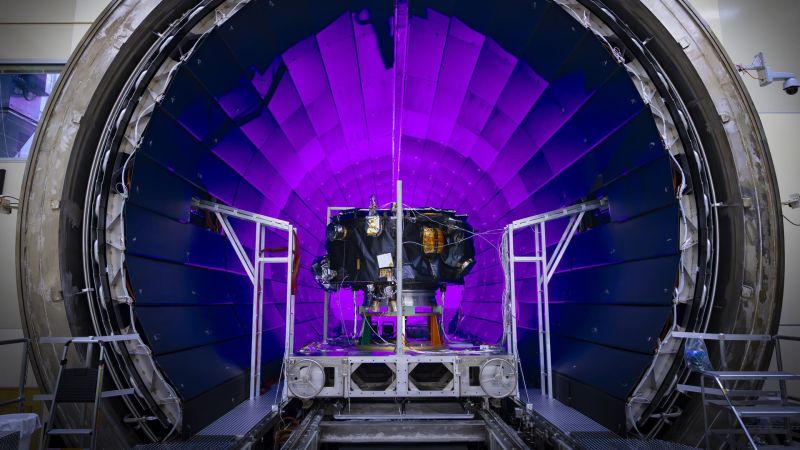
While previous missions, including the Voyager probes, have provided invaluable data after exiting the heliosphere, NASA's new Interstellar Mapping and Acceleration Probe (IMAP) mission aims to significantly enhance our understanding. Launching alongside two other space weather missions, IMAP will focus on the sun's role in forming the solar wind and how this wind interacts with interstellar space at the heliosphere's edge – a region approximately three times the Earth-Pluto distance.
IMAP's ten sophisticated instruments will fill gaps in existing heliosphere maps, improving our knowledge of its protective function against damaging cosmic rays – the universe's most energetic particles. This mission, along with its accompanying launches, will enable scientists to better predict solar storms, which can pose risks to astronauts, satellites, and Earth's infrastructure. Dr. Joe Westlake, director of NASA's Heliophysics Division, aptly described the trio of missions as the 'ultimate cosmic carpool,' emphasizing their collective contribution to unprecedented insights into space weather.
The concept of the heliosphere emerged in the late 1950s from research on cosmic rays and solar wind, gaining confirmation from missions like Mariner 2 (the first to measure the solar wind) and later, the Pioneer and Voyager probes. Voyager 1 and 2 provided unique snapshots of the heliosphere's boundary, revealing its comet-like shape, while the Interstellar Boundary Explorer (IBEX) has contributed mapping efforts since 2008.
IMAP will revolutionize heliosphere mapping with its advanced instruments, offering 30 times higher resolution than IBEX. From its orbit approximately 1 million miles from Earth, IMAP will monitor the solar wind in real time, study the heliosphere's boundary (between 6 and 9 billion miles away), and even gather data from interstellar space. By tracking energetic neutral atoms (ENAs) – uncharged particles formed from collisions of charged ions and neutral atoms – IMAP will trace their origins, revealing the otherwise invisible boundaries of the heliosphere.
Dr. David McComas, IMAP's principal investigator, highlights the mission's potential to create incredibly detailed, evolving pictures of the heliosphere's interaction region. This detailed mapping will help us comprehend the protective mechanisms of the heliosphere, and the implications of this research extend beyond our solar system, as similar 'astrospheres' have been observed around other stars. The launch of IMAP, alongside the Carruthers Geocorona Observatory and NOAA's SWFO-L1, marks a significant step towards understanding our place in the cosmos and improving space weather prediction. These simultaneous launches demonstrate a coordinated effort to improve our understanding of the space environment and mitigate the risks posed by solar activity.
---
Originally published at: https://edition.cnn.com/2025/09/24/science/heliosphere-spacex-nasa-imap-launch


