
Dome-headed pachycephalosaurians, dinosaurs renowned for their hypertrophied skull roofs and intricate cranial ornamentation, have long captivated paleontologists. Their unique cranial features suggest the evolution of complex social behaviors. However, a scarcity of early diverging taxa has hampered our understanding of their origins and evolutionary trajectory. This research introduces *Zavacephale rinpoche*, a new genus and species, unearthed from Mongolia's Lower Cretaceous Khuren Dukh Formation. Representing the most complete and geologically oldest pachycephalosaurian skeleton discovered to date, *Z. rinpoche* provides crucial insights into the early evolution of this enigmatic group.
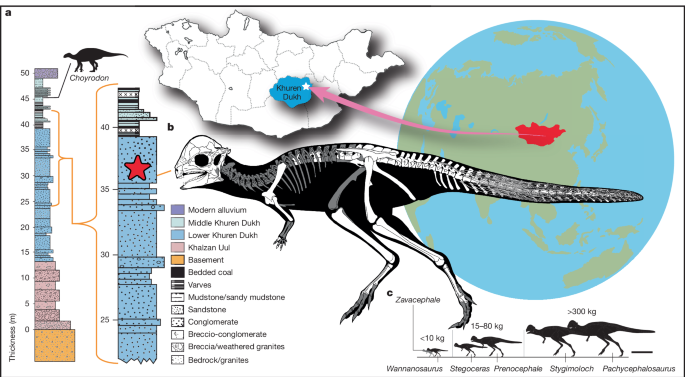
The remarkably well-preserved *Z. rinpoche* specimen showcases a developed frontoparietal dome, the first-ever documented manual elements within the clade, and gastroliths—stones ingested to aid digestion. Phylogenetic analyses place *Z. rinpoche* amongst the earliest diverging pachycephalosaurians, extending the fossil record of the frontoparietal dome by at least 14 million years and shedding light on its macroevolutionary development. Our findings indicate an "frontal-first" pattern in dome evolution, with the frontal bone developing first, and the retention of an open supratemporal fenestra—mirroring proposed developmental pathways in later Cretaceous taxa.
Intriguingly, osteohistological analysis of the frontoparietal dome and hindlimb reveals a fascinating decoupling of sociosexual and somatic maturity. This suggests that advanced dome development preceded the attainment of full body size in early pachycephalosaurians, highlighting a complex interplay between growth and sexual selection. This discovery fundamentally alters our comprehension of pachycephalosaur evolution, providing a critical stepping stone towards a more comprehensive understanding of their biology and behavior during the Early Cretaceous period.
---
Originally published at: https://www.nature.com/articles/s41586-025-09213-6


