
Ten years ago, on September 14, 2015, the world witnessed a monumental scientific achievement: the first-ever detection of gravitational waves. This groundbreaking discovery, a century after Albert Einstein's prediction in his theory of general relativity, opened a new window into the cosmos. Einstein's genius, armed only with paper, pencil, and pure intellect, laid the groundwork for this incredible leap forward.
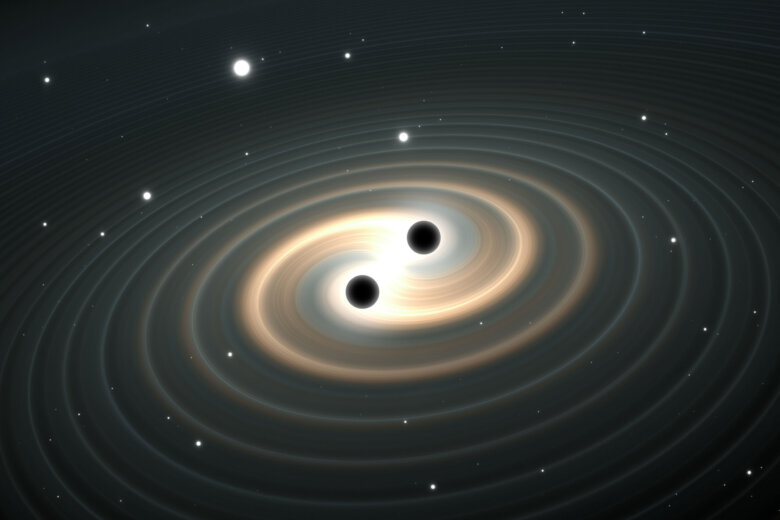
The initial detection, confirmed months later and announced on February 11, 2016, marked the beginning of a new era in astronomy. What was once a theoretical concept became a tangible reality, paving the way for unprecedented advancements in our understanding of the universe.
Since then, the progress has been astonishing. The Laser Interferometer Gravitational-wave Observatory (LIGO), with its detectors in Hanford, Washington, and Livingston, Louisiana, has become a highly efficient gravitational wave detection facility, routinely observing black hole mergers – approximately one every three days. Collaborations with international partners – the Virgo detector in Italy and KAGRA in Japan – have formed the LIGO-Virgo-KAGRA (LVK) network, resulting in the detection of nearly 300 black hole mergers. The current science run, the fourth since 2015, alone has already identified over 200 potential mergers, more than doubling the previous total.
This rapid accumulation of data has fueled further research and technological advancements. Scientists are relentlessly pursuing even greater sensitivity in detection capabilities, with ambitious plans for a space-based detector, the Laser Interferometer Space Antenna (LISA). LISA, with its million-mile-long detection grid formed by three spacecraft and their lasers, promises to unlock entirely new realms of gravitational wave detection and open up unprecedented possibilities for scientific discovery.
The study of gravitational waves holds immense potential for unraveling the mysteries of the universe's origins and evolution. They provide a unique perspective on the most energetic events in the cosmos, offering clues to phenomena that remain largely unknown. The next decade of gravitational wave research promises to be just as revolutionary, revealing more secrets of the universe's evolution than we ever thought possible.
---
Originally published at: https://wtop.com/the-space-place/2025/09/10-years-ago-gravitational-waves-were-detected-for-the-first-time/


