
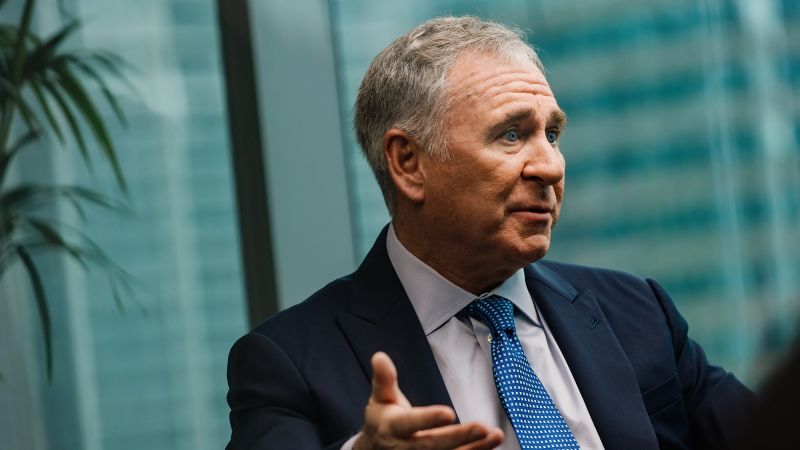
Ken Griffin, the billionaire CEO of Citadel and a known Trump voter, has issued a dire warning about the potential consequences of President Trump's continued attacks on the Federal Reserve. In a scathing Wall Street Journal op-ed co-authored with Anil Kashyap, a professor at the Chicago Booth Business School, Griffin argues that Trump's attempts to influence the Fed's monetary policy are a dangerous gamble with potentially devastating economic repercussions.
The op-ed highlights the risks of undermining the Fed's independence, drawing parallels to the Nixon-era pressure on the central bank that contributed to the Great Stagflation of the 1970s. Griffin and Kashyap warn that Trump's strategy of public criticism and pressure for more permissive inflation policies could lead to significantly higher inflation and long-term interest rates. This, they argue, would disproportionately harm retired Americans, potentially impacting the upcoming midterm elections.
The White House, however, counters that Trump's policies have successfully curbed inflation, citing recent economic data. This claim directly contradicts official statistics, with forecasts predicting a continued rise in consumer prices. The upcoming CPI report is expected to show a year-over-year increase of 2.9% in August, a significant rise from previous months.
Griffin's outspoken criticism stands in stark contrast to the silence of many other CEOs, who have largely avoided publicly criticizing the president. While some bank CEOs have defended the Fed's independence, they've carefully avoided directly criticizing Trump. Griffin's willingness to speak out, despite his past support for Trump, underscores the gravity of the situation.
The op-ed further details two key risks associated with Trump's actions. Artificially low interest rates, encouraged by political pressure, could overheat the economy and exacerbate inflation, fueling voter discontent. Furthermore, eroding the Fed's credibility could lead to a loss of investor confidence, resulting in higher long-term borrowing costs for both the government and individuals. This, the authors emphasize, is a threat to long-term economic stability.
Griffin and Kashyap conclude by stressing the crucial importance of an independent Federal Reserve, capable of making unpopular but necessary decisions to maintain price stability. They argue that the Fed's credibility, painstakingly built over decades, is not limitless and is at serious risk under current pressures. The authors implore the administration to recognize the long-term damage of undermining this crucial institution.
---
Originally published at: https://edition.cnn.com/2025/09/08/economy/trump-fed-powell-ken-griffin


