
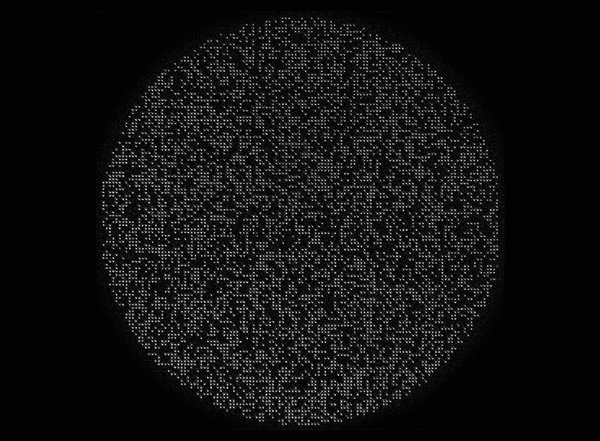
The quest for powerful quantum computers capable of tackling complex scientific problems has taken a giant leap forward. A team of physicists at Caltech has created the largest-ever array of neutral-atom qubits, a groundbreaking achievement that significantly advances the field of quantum computing. Their record-breaking array boasts an impressive 6,100 qubits, far surpassing previous attempts which only managed hundreds.
This milestone is crucial because scaling up the number of qubits is paramount to building practical, error-corrected quantum computers. Unlike classical bits, qubits leverage the principles of quantum mechanics, specifically superposition, to perform computations. However, this fragility necessitates the use of redundant qubits to mitigate errors, requiring quantum computers to contain hundreds of thousands, if not millions, of qubits to perform useful computations. This Caltech research brings us significantly closer to that reality.
The team utilized optical tweezers—highly focused laser beams—to trap thousands of individual cesium atoms in a precisely arranged grid. Remarkably, the size of the array did not compromise the quality of the qubits. The researchers maintained superposition for approximately 13 seconds – almost ten times longer than previous similar arrays—while achieving 99.98% accuracy in manipulating individual qubits. This simultaneously achieving both high quantity and high quality represents a substantial breakthrough.
Furthermore, the researchers demonstrated the ability to move these atoms across the array while preserving their superposition. This maneuverability is a key advantage of neutral-atom quantum computers, enabling more efficient error correction compared to other approaches like superconducting qubits. This ability to 'shuttle' qubits is akin to balancing a glass of water while running; a delicate balancing act that underlines the impressive precision of this work.
The next crucial step is implementing quantum error correction on this scale. This Caltech research strongly suggests that neutral-atom qubits are a viable pathway to achieve this. Error correction in quantum computing is significantly more challenging than in classical computing, due to the 'no-cloning theorem', which prohibits simple copying of qubits. Instead, more sophisticated strategies are required.
The Caltech team's future plans involve entangling these qubits. Entanglement—where particles become correlated and behave as a single unit—is essential for performing complex quantum computations and is the key to unlocking the true power of quantum computers: simulating nature itself at a fundamental level. This includes modeling quantum fields that govern space-time, potentially leading to groundbreaking discoveries in materials science and other fields.
This research, published in Nature, was funded by various organizations including the Gordon and Betty Moore Foundation, the National Science Foundation, and the U.S. Department of Energy, highlighting the significant investment and global interest in advancing quantum computing technology.
---
Originally published at: https://www.caltech.edu/about/news/caltech-team-sets-record-with-6100-qubit-array


