
For the first time, scientists have precisely measured the recoil velocity of a black hole born from a cataclysmic collision. This groundbreaking achievement utilizes data from gravitational waves, ripples in spacetime predicted by Einstein and first detected in 2015. The event, designated GW190412, involved the merger of two black holes of vastly different masses – one 29.7 times and the other 8.4 times the mass of our sun – located 2.4 billion light-years away.
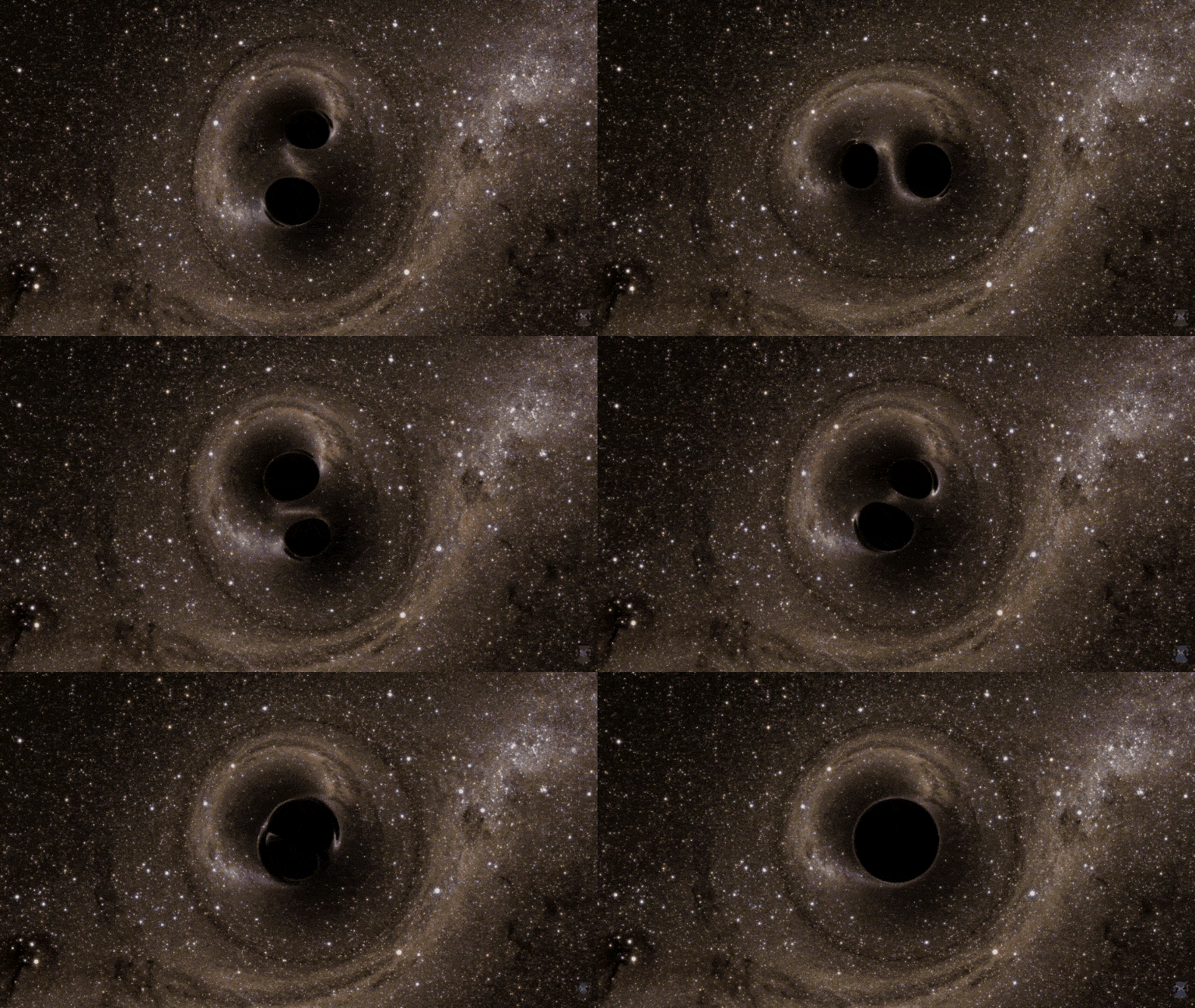
The significant mass disparity resulted in a phenomenon known as a "natal kick," causing the newly formed black hole to be propelled through space at an astonishing speed. By analyzing the gravitational wave signals from different angles, researchers were able to determine both the direction and velocity of this cosmic recoil. Their findings, published in Nature Astronomy, reveal that the newborn black hole shot away at over 31 miles per second (50 kilometers per second).
This speed is remarkable enough to eject the black hole from its original star cluster, likely a dense globular cluster. This escape velocity has profound implications for understanding the formation of supermassive black holes. If a newly formed black hole is ejected, it prevents further mergers that could contribute to the growth of these colossal cosmic entities, which can be 100,000 to 50 billion times the mass of our sun.
The ability to measure this "natal kick" is a testament to the power of gravitational wave astronomy. It allows scientists not only to detect these cosmic events but also to reconstruct the three-dimensional motion of objects billions of light-years away, using only the subtle distortions in spacetime. This achievement builds upon earlier theoretical work that predicted the phenomenon but lacked observational evidence. The precise measurement of the kick's speed provides crucial insights into the dynamics of black hole mergers and their influence on large-scale cosmic structures.
Future research will focus on identifying more black hole mergers, combining observations from gravitational waves with visible light data to refine our understanding of these powerful cosmic events and enhance our knowledge of black hole evolution and the formation of supermassive black holes.
---
Originally published at: https://www.livescience.com/space/black-holes/scientists-measure-the-natal-kick-that-sent-a-baby-black-hole-careening-through-space-for-the-first-time


