
Meiosis, the specialized cell division producing gametes, relies on precise chromosome pairing and recombination to ensure genetic diversity and proper inheritance. This process involves the formation of Holliday junctions (HJs), branched DNA structures crucial for crossing-over events. However, the regulatory mechanisms governing HJ formation, stability, and resolution remain incompletely understood.
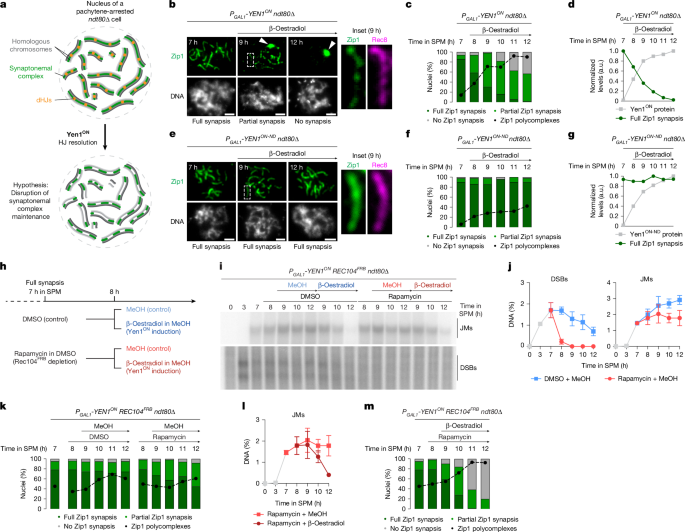
This research unveils a critical feedback loop between HJs and a group of meiosis-specific proteins known as ZMMs (Zip1-4, Msh4-5, Mer3, Spo16). The study uses a sophisticated experimental system in budding yeast, employing conditional HJ resolution and ZMM depletion, to dissect this interaction. The findings reveal that HJs are not merely passive intermediates but actively maintain the synaptonemal complex (SC), a proteinaceous structure essential for homologous chromosome pairing.
Mechanistically, HJs ensure the continued association of ZMM proteins with recombination nodules. In turn, ZMMs promote SC polymerization while protecting HJs from premature processing by non-crossover pathways. This reciprocal feedback loop sustains chromosome synapsis until the appropriate cell cycle stage, when HJ resolvases are activated to resolve the junctions.
Critically, the HJ-ZMM interplay suppresses the formation of new double-strand breaks (DSBs), thereby preventing the activation of the DNA damage response and ensuring that meiosis progresses without unrepaired breaks. This careful regulation directly contributes to crossover assurance—ensuring that at least one crossover event occurs per chromosome pair.
Experiments involving conditional depletion of ZMM proteins and HJ resolvases demonstrate the essential and continuous role of ZMMs in SC maintenance and the prevention of premature HJ resolution. Furthermore, the study demonstrates the reversible nature of SC disassembly, revealing that HJs can serve as a platform for SC reassembly. This suggests that HJs maintain interhomologue connections, providing anchor points for ZMM proteins to initiate SC polymerization.
The implications of this research extend beyond budding yeast. The intricate regulatory mechanism described may operate in other organisms where DSB formation and SC assembly are intertwined. Understanding this fundamental interplay between HJs and ZMM proteins offers crucial insights into the precise control of meiotic recombination, a process critical for maintaining genome integrity and driving evolutionary change.
---
Originally published at: https://www.nature.com/articles/s41586-025-09559-x


