
While planets often steal the cosmic spotlight, our solar system's diverse moons – boasting features like active volcanoes, subsurface oceans, and hydrocarbon seas – reveal their profound importance. The fundamental physics governing the creation of large planets suggests that moon formation is a natural, unavoidable consequence, implying that our galaxy should be teeming with countless lunar companions.
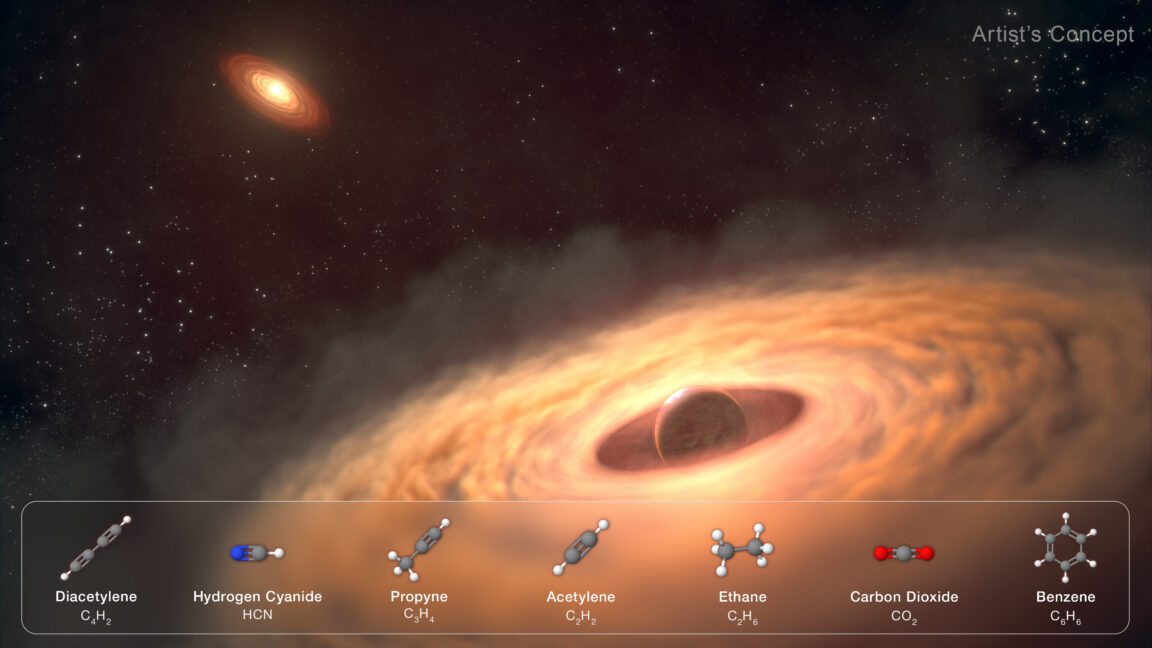
Despite compelling theoretical evidence and tantalizing glimpses, definitive proof of an exomoon has remained elusive. However, astronomers have observed nascent exoplanets encircled by protoplanetary disks – the precursors to moons. A recent groundbreaking observation by the James Webb Space Telescope (JWST) has now provided unprecedented insights into one such disk orbiting a colossal "super-Jupiter." Strikingly, this moon-forming disk is brimming with small carbon-based molecules, a stark contrast to its host star's adjacent planet-forming disk, which appears predominantly water-rich.
The quest for exomoons and their formative disks employs distinct observational strategies. Detecting an orbiting exomoon typically relies on its subtle gravitational tug, which causes minute variations in its host planet's transit timing across its star. Moon-forming disks, however, exist only in the early, fleeting stages of an exoplanetary system's development. These vast, ring-like structures, reminiscent of a grander version of Saturn's rings but with enough mass to coalesce into moons, dissipate or condense within a few million years. Their gravitational effect is often too uniform, and their intrinsic light emission too faint, to be discernible against the glare of their parent star. Consequently, identifying these elusive nurseries demands searching near very young stars and focusing on planets located far enough from their stellar hosts to allow for clear resolution.
Fortuitously, several exoplanets fitting these specific criteria have been directly imaged. These directly observed worlds are typically young, massive "super-Jupiters" that glow with residual heat from their formation, making them detectable even at vast distances from their stars. Previous investigations hinted at the presence of moon-forming disks around some of these giants, but detailed information about their composition remained largely unknown – until now.
The phenomenal sensitivity and resolution of the JWST have fundamentally altered this situation. Astronomers Gabriele Cugno and Sierra Grant directed the telescope towards CT Cha, a young, Sun-like star approximately 625 light-years away. CT Cha is orbited by CT Cha b, a colossal super-Jupiter, exceeding Jupiter's mass by over 15 times, orbiting its star at a distance roughly 15 times greater than Neptune's distance from our Sun. This separation made it possible to isolate and study the planet and its immediate surroundings. Initial spectroscopic analysis near CT Cha b quickly indicated the presence of various chemicals, including light carbon-based molecules like ethane, acetylene, and carbon dioxide.
With knowledge of the potential chemical culprits and the planet's location, Cugno and Grant meticulously configured the JWST's spectrograph to target the peak emissions of these common molecules. By analyzing the observed spectrum, they successfully modeled the moon-forming disk's emissions, identifying the specific chemicals present and their corresponding temperatures. Many of these compounds were detected below 250 Kelvin, suggesting they were released from icy materials through sublimation or collisions. Notably, acetylene appeared warmer, indicating a higher concentration closer to the planet. What proved truly remarkable was the stark contrast: a similar spectroscopic examination of the host star revealed no detectable carbon-based chemicals in its planet-forming disk. Instead, the dominant chemical signature near the star was water molecules – substances conspicuously absent from CT Cha b's moon-forming disk.
This dramatic difference challenges the intuitive notion that materials within a planet-forming disk would be uniformly distributed. The reality is far more intricate, as various materials solidify into ice at different distances from the star, creating distinct "snow lines" where their concentrations peak. Furthermore, CT Cha b resides in a region where standard core-accretion models of planet formation struggle to explain the existence of such a massive giant. This leads Cugno and Grant to hypothesize that the planet likely formed through a disk instability – a process more commonly associated with binary star systems but also capable of producing massive planets or brown dwarfs. Intriguingly, observations have shown a trend where Sun-like stars possess water-rich planet-forming disks, while smaller stars and brown dwarfs exhibit carbon-rich disks. The discovery around CT Cha b suggests this pattern extends to giant exoplanets, adding another layer of complexity. The underlying reasons for this chemical dichotomy remain a subject of ongoing research and multiple, often complementary, hypotheses.
Fundamentally, the existence of moon-forming disks aligns with our current astronomical models; if planet and star formation theories are accurate, such material reservoirs are an inevitability. The high prevalence of exoplanets discovered reinforces the validity of these models. While their presence is anticipated, direct confirmation is always invaluable. This pioneering study, providing a detailed chemical blueprint of a moon-forming disk, offers a critical foundation. Future investigations building on these findings promise to refine our understanding, enabling the development of more sophisticated models and painting an ever-clearer picture of the intricate genesis of moons across the cosmos.
---
Originally published at: https://arstechnica.com/science/2025/09/researchers-find-a-carbon-rich-moon-forming-disk-around-giant-exoplanet/


