
For the very first time, astronomers have peered into the cradle of nascent moons, uncovering the intricate chemical recipe brewing within a moon-forming disk around a distant planetary body. This pioneering observation, made possible by the unparalleled capabilities of the James Webb Space Telescope (JWST), promises to revolutionize our understanding of how moons, including those orbiting the gas giants in our own solar system, come into existence.
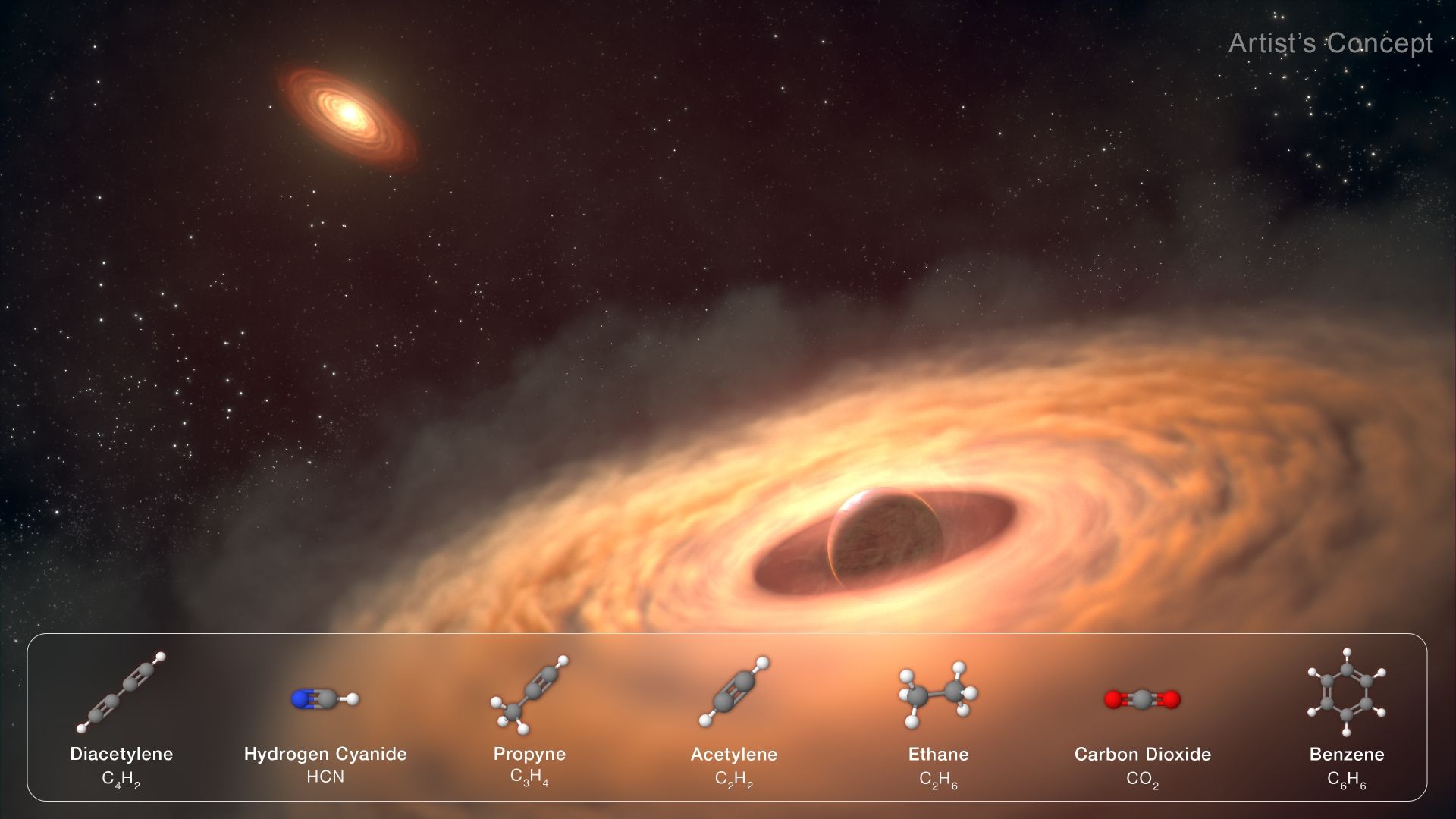
Utilizing the medium-resolution spectrograph of its Mid-Infrared Instrument (MIRI), the JWST focused on the disk encircling a peculiar object known as CT Cha b. This celestial body, boasting a mass 17 times that of Jupiter, sits on the ambiguous boundary between a massive exoplanet and a low-mass brown dwarf, a distinction still being refined by scientists.
CT Cha b orbits a youthful star, merely two million years old, located approximately 625 light-years away within the constellation Chamaeleon. While no moons have yet been directly detected, the surrounding disk is strongly believed to be a dynamic moon-forming environment. The JWST's precise measurements have now unveiled a rich assortment of carbon-bearing molecules within this disk, including acetylene, benzene, carbon dioxide, diacetylene, ethane, hydrogen cyanide, and propyne – essentially, the fundamental building blocks required for moon construction.
This marks the inaugural instance where the chemical composition of such a moon-forming disk has been directly characterized, though previous observations hinted at interesting carbon chemistry. Sierra Grant from the Carnegie Institution for Science in Washington, who co-led the observations, remarked on the dedication required: "We saw molecules at the location of the planet [in archive data], and so we knew there was stuff in there worth digging for and spending a year trying to tease out of the data. It really took a lot of patience."
Gabriele Cugno of the University of Zürich, who also spearheaded the study, underscored the significance: "We are seeing what material is accreting to build the planet and moons." Cugno further explained that CT Cha b is itself situated within a larger circumstellar planet-forming disk, albeit at an immense distance of 440 astronomical units (about 41 billion miles) from its parent star. To put this in perspective, Neptune, our solar system's most distant planet, is only about 2.8 billion miles from the Sun.
CT Cha b's considerable separation from its star was crucial, shielding it from stellar glare and enabling its initial discovery through direct imaging by the Very Large Telescope (VLT) in Chile back in 2006. The VLT's SPHERE instrument later confirmed the presence of its planet-forming disk. Intriguingly, earlier JWST observations revealed that this *larger* planet-forming disk was abundant in ice grains but notably deficient in carbon. This contrast suggests that the carbon-rich chemistry now observed in the *moon-forming* disk around CT Cha b evolved independently over the last two million years, raising fundamental questions about the universality of such chemical pathways in moon formation.
The researchers are eager to decipher the entire process. "How do these moons come to be? What are their ingredients? What physical processes are at play, and over what timescales?" Cugno articulated the overarching questions. "Webb allows us to witness the drama of moon formation and investigate these questions observationally for the first time." While definitive exomoon detections remain elusive, the universe is likely teeming with moons, potentially outnumbering planets, as evidenced by the numerous satellites of Jupiter and Saturn.
To truly grasp the genesis of moons, including those in our own solar system, scientists agree that observing other systems currently in the throes of formation is paramount. CT Cha b provides an unparalleled cosmic laboratory. Future endeavors will involve deeper investigations into CT Cha b and extensive surveys of other potential moon-forming disks, seeking commonalities and divergences that can refine our models of moon creation. These groundbreaking findings were published on September 29 in The Astrophysical Journal Letters.
---
Originally published at: https://www.space.com/astronomy/james-webb-space-telescope/how-do-you-build-a-moon-the-james-webb-space-telescope-has-just-given-us-our-best-look


