
For decades, the ritual of online shopping followed a predictable, often multi-step path: browse, select, add to cart, and finally, checkout. This process saw its first significant disruption with social media platforms integrating direct product displays, turning feeds into instant marketplaces. Now, OpenAI and Stripe are taking this evolution a colossal step further, integrating the entire purchasing journey directly into AI chat interfaces. This innovation represents a significant leap towards frictionless commerce, enabling consumers to transition from an initial idea to a confirmed purchase within moments.
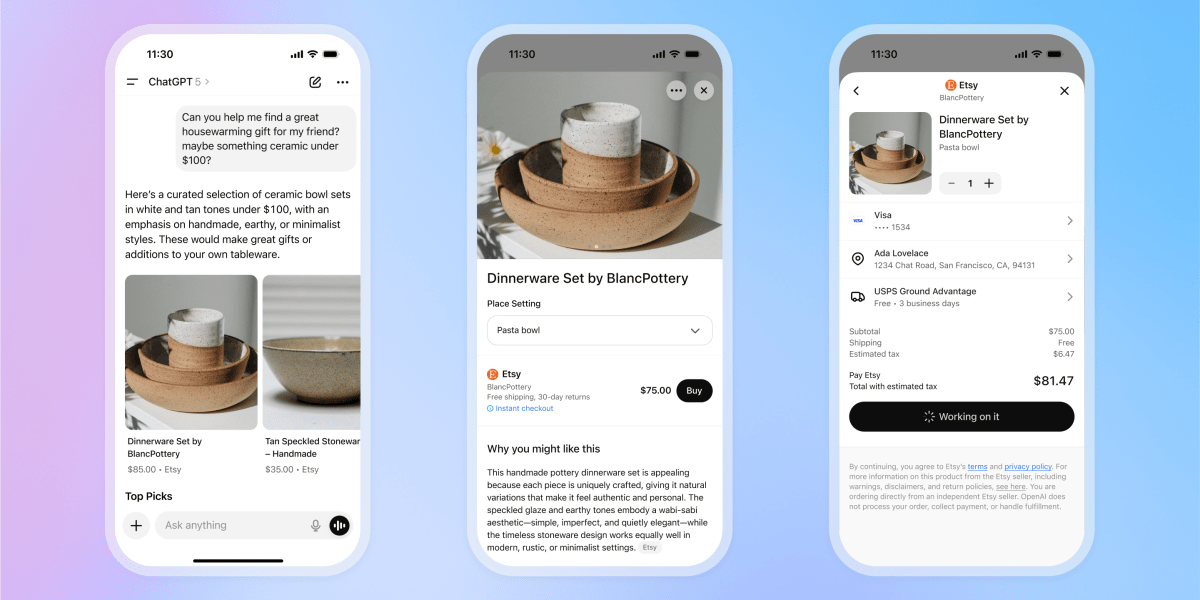
This week marked the debut of the “Instant Checkout” feature within ChatGPT, a groundbreaking initiative powered by a new, co-developed commerce protocol. Initially rolling out for U.S.-based Etsy merchants, this functionality is slated for rapid expansion to over a million Shopify sellers, encompassing high-profile brands like Glossier, Skims, Spanx, and Vuori. The underlying Agentic Commerce Protocol (ACP) leverages an open standard, specifically tailored for commerce and payments, bridging AI models with robust business systems. Stripe's instrumental role brings crucial elements like advanced fraud prevention, extensive global payment rails, and a vast network of merchants, making ACP immediately viable for millions of enterprises.
Crucially, the implications of this protocol extend far beyond OpenAI's ecosystem. Given its open-source nature, any AI assistant—from industry giants like Google's Gemini and Anthropic's Claude to emerging players like TikTok's AI and xAI—could adopt these same foundational rails. This widespread accessibility means that conversational shopping could proliferate across the internet at a pace that many brands may not be fully prepared to handle.
Such a fundamental shift could signal the end of Google and Amazon's long-standing reign as the primary entry points for online retail. While these incumbents certainly have the option to integrate the open protocol themselves and join the in-chat shopping movement, the larger significance lies in the potential for a complete overhaul of online shopping’s foundational structure—a possibility unseen in two decades. If this transformation gains traction, its ramifications will be profound, influencing everything from how consumers make purchasing decisions to the strategies brands employ for marketing their products.
OpenAI’s decision to make the protocol open source, thereby allowing competitors to utilize it, stems from a strategic, merchant-centric perspective. Michelle Fradin, ChatGPT’s product lead, explained that the paramount objective was to create a system that was “incredibly easy for the entire ecosystem—merchants and developers—to adopt.” She clarified that even if competitors benefit, the overall outcome is “net-beneficial,” as it minimizes integration complexities for merchants and ultimately boosts sales. The overwhelming merchant demand for such a scalable solution drove the open-source approach.
Naturally, not every brand or retailer will immediately embrace this new paradigm. Adopting ACP, even as an open-source solution, involves ceding some degree of direct control over customer relationships, a connection many businesses meticulously cultivate. Furthermore, the question of transaction fees could be a deterrent for sellers operating on razor-thin margins. However, for a multitude of companies, particularly larger brands, the unparalleled, frictionless reach offered by AI-powered shopping is likely to outweigh concerns regarding brand experience control.
Beyond the potential adoption by other platforms, direct integration within ChatGPT's search results presents a clear advantage due to the chatbot’s immense popularity. Fradin confirmed that, in addition to Etsy and Shopify, OpenAI is actively collaborating with several other major retailers, whose participation in ChatGPT's Instant Checkout will be revealed in due course.
To ensure their products are surfaced effectively within ChatGPT’s Instant Checkout recommendations, brands and merchants must undertake specific data preparation. This involves furnishing the AI model with structured, rich, and highly detailed product information that it can readily interpret. Fradin emphasized that merchants are actively supplying comprehensive “product feeds”—essentially structured catalogs with in-depth descriptions, real-time pricing, and availability data. In some instances, brands are even providing more granular details than what's available on their own websites, all in an effort to enhance their visibility. This trend points to the emergence of a new discipline: “AI Optimization” (AIO), envisioned as the successor to traditional SEO, focused on fine-tuning product data for optimal AI assistant surfacing.
At its core, ACP positions ChatGPT as a powerful new arbiter of product recommendations. Consumers might no longer navigate Google search results, scroll through Amazon’s “customers also bought” sections, or consult third-party reviews. Instead, the AI assistant itself will increasingly guide purchase decisions. This profound shift inevitably raises complex questions: How will ChatGPT determine its recommendations? Will it offer a curated menu of options or steer users towards a single product? And, in the future, could OpenAI introduce monetization models, allowing vendors to pay for boosted placement, thus transforming conversational commerce into a pay-to-play channel?
For the time being, Fradin asserts that ChatGPT’s shopping recommendations are entirely AI-driven, unlike traditional search engines that guard proprietary algorithms. There isn't a fixed formula for merchants to optimize against; rather, the more high-quality and comprehensive product information the model receives, the more accurately and relevantly it can surface results. Fradin concluded by noting, “We expect to see a lot of evolution in the new version of AIO over time. I think we’re just at the beginning of this space.”
---
Originally published at: https://fortune.com/2025/09/30/openai-stripe-acp-chatgpt-instant-checkout-could-blow-up-online-shopping/


