
SpaceX is gearing up for its next Starship test flight, which, on the surface, might resemble previous missions. However, this launch will incorporate several crucial advancements, including the reuse of a Super Heavy booster powered by 24 flight-proven Raptor engines, pushing the boundaries of rocket reusability.
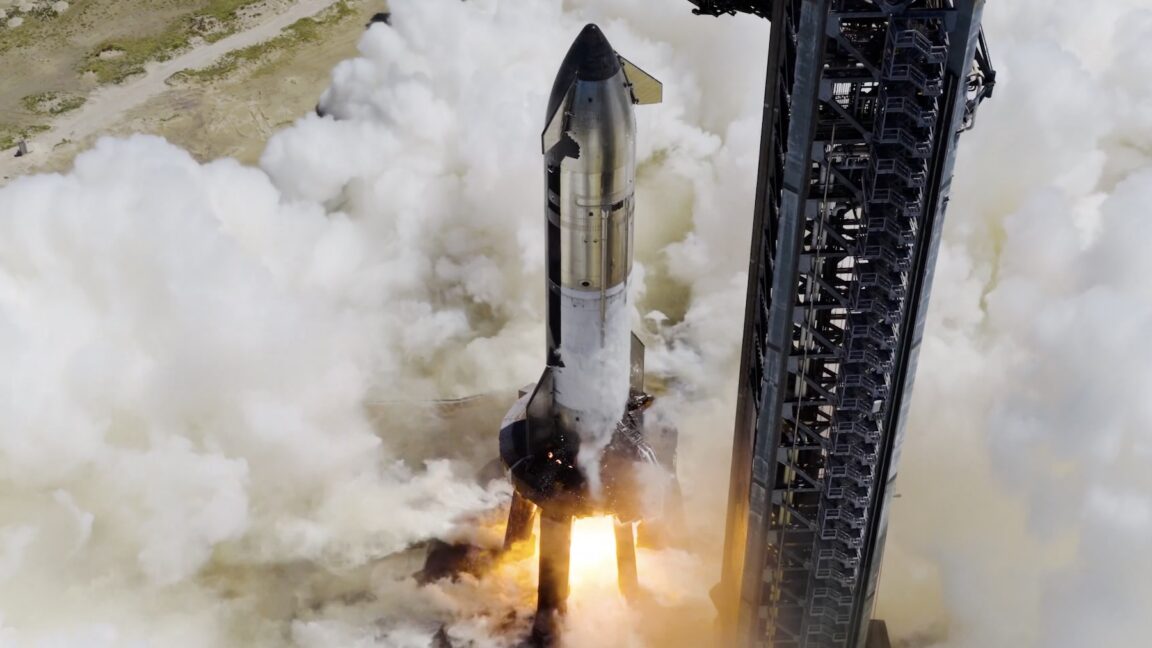
The mission plan outlines a familiar trajectory: the Super Heavy booster is slated for a controlled splashdown in the Gulf of Mexico, near SpaceX's South Texas launch facility. Following separation, Starship, the upper stage, will embark on a suborbital journey, culminating in an atmospheric reentry over the Indian Ocean before an intentional water landing northwest of Australia.
Key objectives for this flight include further testing of Starship's satellite deployer mechanism and a critical in-space reignition of a Raptor engine to precisely fine-tune the vehicle's reentry trajectory. These maneuvers are vital precursors for achieving future orbital Starship flights, as all prior ascents have been intentionally capped below orbital velocity.
The preceding Starship test flight on August 26 marked a significant success, allowing SpaceX to recover from a series of four prior setbacks (three in-flight and one ground-based). With the upcoming launch, provisionally set for October 13, the company aims to validate its recent achievements and demonstrate consistent reliability.
Designated as the eleventh full-scale Starship test and the fifth this year, this mission holds particular significance as it will be the final flight before a hiatus until early 2026. This break will precede the introduction of the much-anticipated Starship Version 3, a larger and more advanced iteration.
Despite surface similarities, the upcoming flight plan incorporates distinct modifications, primarily impacting Starship's reentry phase. During this critical period, the vehicle's heat shield will endure extreme temperatures reaching 2,600°F (1,430°C). In a deliberate move, mirroring the previous mission, SpaceX has strategically omitted a number of the thousands of ceramic thermal protection tiles to actively 'stress-test vulnerable areas' of the spacecraft.
According to SpaceX, certain intentionally removed tiles are situated in regions where they directly interface with Starship's stainless steel structure, lacking the additional safeguard of an ablative layer.
Notably, a recent update from SpaceX made no mention of the experimental metallic tiles that were present on the August flight. Bill Gerstenmaier of SpaceX had previously indicated that these metallic tiles "didn't work so well," despite the vehicle successfully executing its targeted splashdown. Post-landing camera footage revealed extensive orange discoloration on one side of the Starship, which Gerstenmaier attributed to oxidation of these metallic tiles during flight.
The inclusion of metallic tiles was an exploratory effort to assess their performance compared to traditional ceramic insulators. Engineers are continuously refining the heat shield's architecture to ensure its resilience against reentry and landing stresses. Any compromise to the heat shield necessitates refurbishment, potentially jeopardizing SpaceX's foundational goal of achieving full and rapid Starship reusability.
Looking ahead, possibly as early as next year, SpaceX intends to demonstrate a groundbreaking return-to-launch-site maneuver for Starship. This ambitious objective involves bringing the vehicle back to its Starbase, Texas, facility, executing an engine-braked descent, and ultimately being caught by the launch pad's automated grappling arms.
A novel test objective for the upcoming Starship flight is a 'dynamic banking maneuver' during the terminal phase of its descent. This specific action is designed to simulate the flight path Starship will undertake when returning to Starbase for landing, providing crucial data for refining its subsonic guidance algorithms.
Though full recovery and reuse of Starship's upper stage remain a future milestone, SpaceX is advancing another critical aspect of reusability: the Super Heavy booster. Flight 11 will notably be the second instance of a Super Heavy booster being reused. Booster 15, which previously flew in March and was successfully caught by the Starbase launch tower after its suborbital journey, will carry 24 'flight-proven' Raptor engines out of its total of 33 methane-fueled powerplants.
Consistent with the previous mission, the Super Heavy booster will execute a controlled splashdown off the South Texas coast, rather than attempting a return-to-pad landing at Starbase. SpaceX states the booster's primary goal is to validate a 'unique landing burn engine configuration' that is envisioned for future iterations of the Super Heavy design.
This revised landing sequence for the booster will commence with 13 of its 33 engines, then transition to five engines, before ultimately throttling down to just the three central engines for the final phase of the burn. This represents an evolution from the previous sequence, which directly reduced thrust from 13 to three engines. SpaceX highlights that the inclusion of the five-engine segment offers 'additional redundancy for spontaneous engine shutdowns.' The overarching aim of this test is to meticulously 'measure the real-world vehicle dynamics' during these critical engine transition phases.
Post-Flight 11, SpaceX's focus will shift towards the development of Starship V3, the next-generation design. This advanced configuration is intended to be the first truly orbital version, enabling the deployment of an upgraded fleet of larger, more powerful Starlink internet satellites. Starship V3 is also slated to pioneer orbital refueling – a complex maneuver never before accomplished with cryogenic propellants between two spacecraft. In-space refueling is crucial for Starship to acquire sufficient energy to embark on journeys beyond Earth's orbit, facilitating missions to the Moon and Mars, central to the long-term visions of both NASA and Elon Musk.
The maiden flight of Starship V3 is projected for early 2026, utilizing a new launch pad currently undergoing final preparations adjacent to Starbase's existing facility. Bill Gerstenmaier, SpaceX's VP of build and flight reliability, recently shared that an additional suborbital test flight for Starship V3 is anticipated. Should this prove successful, the subsequent mission, potentially Flight 13, could aim for low-Earth orbit later that year.
---
Originally published at: https://arstechnica.com/space/2025/09/spacex-has-a-few-tricks-up-its-sleeve-for-the-last-starship-flight-of-the-year/


