
A groundbreaking discovery in astrophysics has provided the clearest evidence yet of a black hole collision, confirming decades-old predictions by Albert Einstein and Stephen Hawking. Detected by the Laser Interferometer Gravitational-Wave Observatory (LIGO), the event, designated GW250114, involved two black holes, each approximately 30 to 35 times the mass of our sun, merging to form a single black hole roughly 63 times the sun's mass. This merger, located approximately 1 billion light-years away, was observed with unprecedented detail due to significant improvements in LIGO's sensitivity.
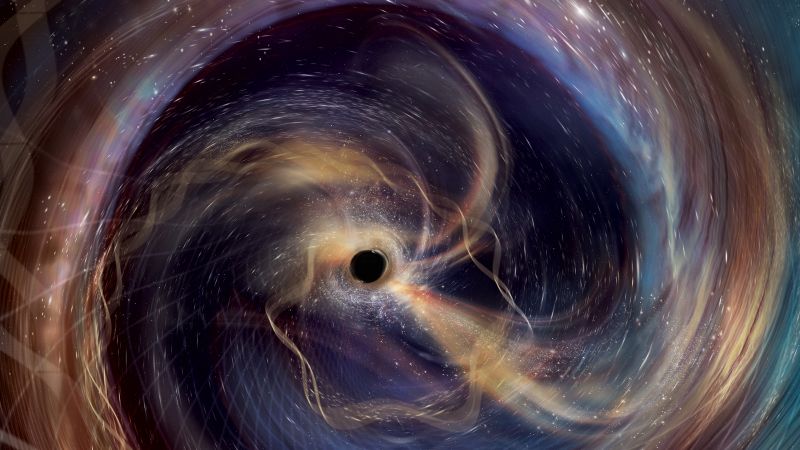
The exceptionally precise data allowed researchers to confirm two key predictions. Firstly, the observation validates New Zealand mathematician Roy Kerr's 1963 prediction, based on Einstein's general relativity, that black holes are fundamentally simple objects describable by a single equation, defined solely by their mass and rotation rate. The merger's 'ringing,' a post-collision vibration akin to a struck bell, revealed two distinct modes – a fundamental mode and an overtone – providing strong evidence for this simplicity. The characteristics of this 'ringing' directly correlate to the black hole's mass and spin, offering a unique test of Kerr's theory.
Secondly, the data provides compelling confirmation of Stephen Hawking's 1971 theorem, which posits that the total surface area of a black hole can never decrease after a merger. The high-fidelity data from GW250114 allowed researchers to precisely measure the surface areas of the initial black holes and the resulting merged object, definitively demonstrating the increase in area, a critical validation of Hawking's work. This confirmation is particularly significant because it provides more evidence for the compatibility of general relativity and quantum mechanics, a major goal in modern physics.
The improved sensitivity of LIGO, achieved through upgraded lasers and mirrors, dramatically reduced background noise, enabling an observation three times more precise than the groundbreaking detection of 2015. This enhanced capability allows for more stringent tests of fundamental principles of gravity, demonstrating the evolution of gravitational wave astronomy and LIGO's role in unlocking the universe's secrets. The ongoing advancements in LIGO's technology promise even more detailed observations in the future, further refining our understanding of spacetime and the fundamental forces governing the cosmos.
---
Originally published at: https://edition.cnn.com/2025/09/11/science/black-hole-collision-einstein-hawking


