
NASA's James Webb Space Telescope has delivered breathtaking new images of Sagittarius B2, the Milky Way galaxy's most active star-forming region. Located just a few hundred light-years from the galactic center's supermassive black hole, this massive molecular cloud is a crucible of stellar birth, densely packed with stars, nascent star-forming clouds, and intricate magnetic fields. While containing only 10% of the galactic center's gas, Sagittarius B2 surprisingly accounts for a remarkable 50% of its star formation.
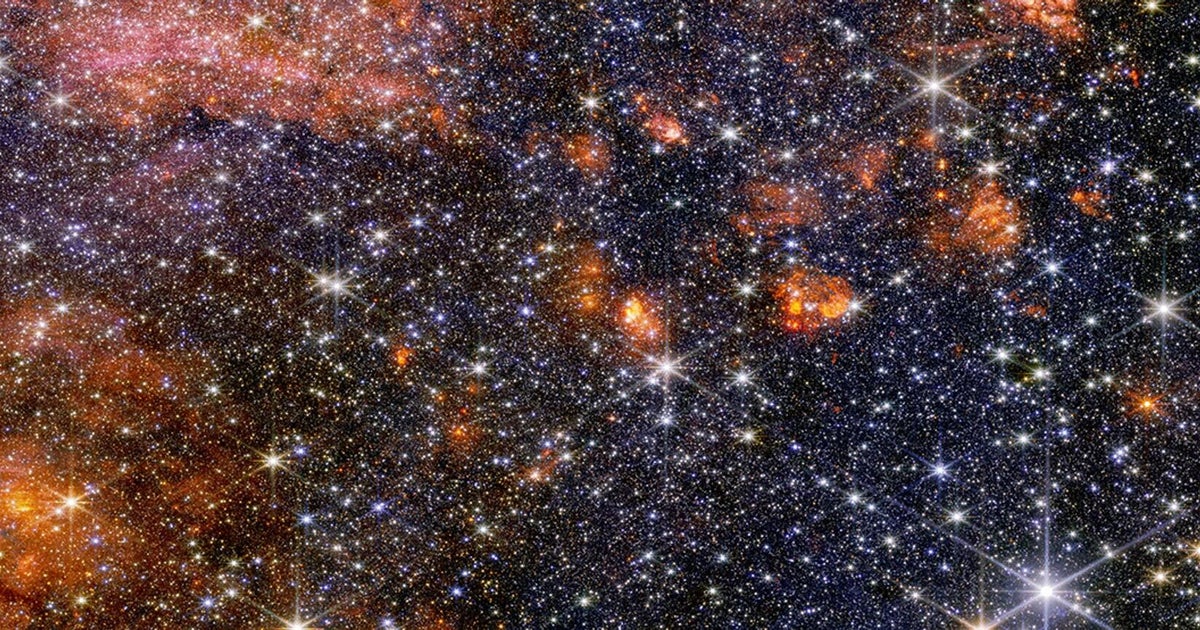
Webb's advanced infrared capabilities pierce the dust and gas veils obscuring this vibrant region, revealing unprecedented detail. Images from the Mid-Infrared Instrument (MIRI) showcase Sagittarius B2 North, a particularly rich molecular zone, portraying gas and dust with unparalleled clarity. Stars within this dense environment appear as mere blue pinpricks against the backdrop of cosmic clouds. In contrast, observations from the Near-Infrared Camera (NIRCam) illuminate colorful stars embedded within glowing gas and dust clouds, offering astronomers crucial data to determine the stars' size, age, and ultimately, better understand the star formation process within Sagittarius B2.
Even with Webb's powerful capabilities, some areas of Sagittarius B2 remain enigmatic. Regions appearing dark and empty are, in fact, so densely packed with gas and dust that even Webb's infrared vision cannot penetrate. These opaque regions, however, are not barren; they represent the future sites of stellar nurseries, cocooning nascent stars within their dust-laden embrace.
This remarkable data raises further intriguing questions. Scientists are particularly interested in unraveling the mystery of why star formation in the Milky Way's central region is surprisingly low, relative to its density. The detailed observations from the Webb telescope offer unprecedented opportunities to address this and other fundamental questions regarding the life cycle of stars. As Nazar Budaiev, a graduate student at the University of Florida and co-principal investigator of this study aptly noted, "Humans have been studying the stars for millennia, and much remains to be understood. For every new revelation Webb unveils, new mysteries emerge, making this an incredibly exciting era of discovery."
---
Originally published at: https://www.cbsnews.com/news/james-webb-space-telescope-images-sagittarius-b2-nasa/


